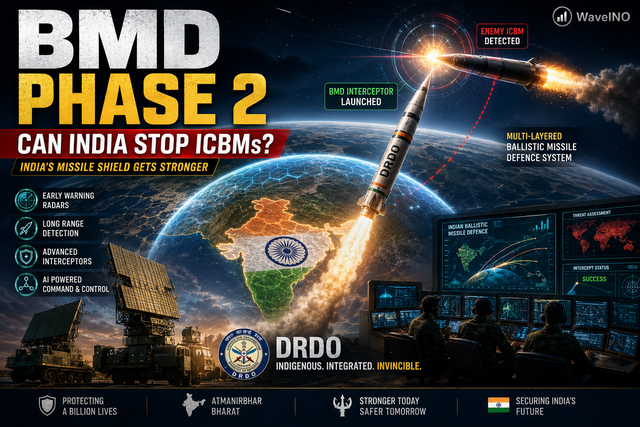
India's defence capabilities have entered a new phase with the continued advancement of the Defence Research and Development Organisation's Ballistic Missile Defence (BMD) Phase 2 program. Designed to strengthen the country's protection against long-range ballistic missile attacks, the project is being viewed as one of the most important strategic defence initiatives undertaken by India in recent years.
As missile technology becomes more advanced and global security challenges evolve, the ability to detect, track, and intercept incoming threats before they reach their targets has become a critical component of national security. DRDO's BMD Phase 2 aims to provide exactly that capability.
What Is BMD Phase 2?
Ballistic Missile Defence (BMD) refers to a system designed to protect a country from ballistic missile attacks by intercepting hostile missiles during different stages of their flight.
India's BMD program has been developed in phases. While earlier systems focused on intercepting shorter and intermediate-range threats, Phase 2 is designed to address more advanced and longer-range missile challenges.
The upgraded architecture combines advanced radar systems, interceptor missiles, tracking technologies, and command-and-control networks to create a multi-layered defensive shield.
The goal is to engage threats at high altitudes and long distances, improving the chances of successful interception.
Why Long-Range Missile Threats Matter
Modern ballistic missiles can travel thousands of kilometers and reach extremely high speeds.
Some advanced systems are capable of carrying conventional or strategic payloads and can strike critical infrastructure, military installations, and urban centers within minutes.
Defending against such threats requires:
Early detection
Accurate tracking
Real-time threat assessment
High-speed interceptor missiles
Integrated command systems
Even a small delay in response can significantly reduce interception opportunities.
This is why nations around the world continue investing heavily in missile defence technologies.
How BMD Phase 2 Works
India's BMD Phase 2 follows a layered defence concept.
Instead of relying on a single interception opportunity, the system is designed to create multiple chances to destroy an incoming missile.
The process generally involves:
Early Detection
Long-range surveillance radars identify and track hostile missile launches soon after they occur.
Threat Assessment
Advanced command systems analyze the trajectory, speed, altitude, and probable target of the incoming missile.
Interceptor Launch
Specialized interceptor missiles are launched to engage the threat before it reaches Indian territory or critical assets.
Multi-Layer Engagement
If necessary, additional interception attempts can be made at different stages of the missile's flight path.
This layered approach significantly increases defensive effectiveness.
Could It Counter ICBM-Class Threats?
One of the most discussed aspects of BMD Phase 2 is its potential ability to engage threats approaching intercontinental ballistic missile (ICBM) capabilities.
While defence experts note that intercepting such advanced missiles remains one of the most difficult tasks in modern warfare, recent DRDO tests indicate substantial progress in developing technologies capable of handling increasingly sophisticated threats.
Successful demonstrations of high-speed interception capabilities suggest that India is moving closer to joining a small group of nations with advanced long-range missile defence systems.
Strategic Benefits for India
The development of BMD Phase 2 offers several strategic advantages.
Enhanced National Security
The system strengthens protection for major cities, military facilities, and critical infrastructure.
Stronger Deterrence
Potential adversaries must account for the possibility that missile attacks could be intercepted before reaching their targets.
Improved Crisis Stability
Defensive capabilities can provide policymakers with additional response options during periods of tension.
Technological Self-Reliance
The program showcases India's growing expertise in indigenous defence research and advanced military technologies.
Part of a Broader Defence Modernization Effort
BMD Phase 2 is not an isolated project.
It complements several other defence initiatives aimed at modernizing India's military capabilities, including:
Advanced air defence systems
Space-based surveillance assets
Integrated command networks
Indigenous missile development programs
Naval defence modernization
Together, these efforts contribute to a more comprehensive national security framework.
Challenges Ahead
Despite significant progress, missile defence remains an extremely complex field.
Future challenges include:
Countering hypersonic weapons
Tracking maneuverable warheads
Integrating multiple defence layers
Maintaining rapid response capabilities
Adapting to evolving threat technologies
Continuous testing, upgrades, and technological innovation will remain essential.
Looking Ahead
DRDO's BMD Phase 2 program represents a major milestone in India's journey toward advanced missile defence capabilities. By developing systems capable of detecting and intercepting long-range threats, India is strengthening its ability to protect critical assets and maintain strategic stability.
While missile defence can never guarantee complete protection against every possible threat, the progress achieved through BMD Phase 2 significantly enhances India's defensive posture. As testing and development continue, the program is expected to play an increasingly important role in safeguarding the nation against the complex security challenges of the future.