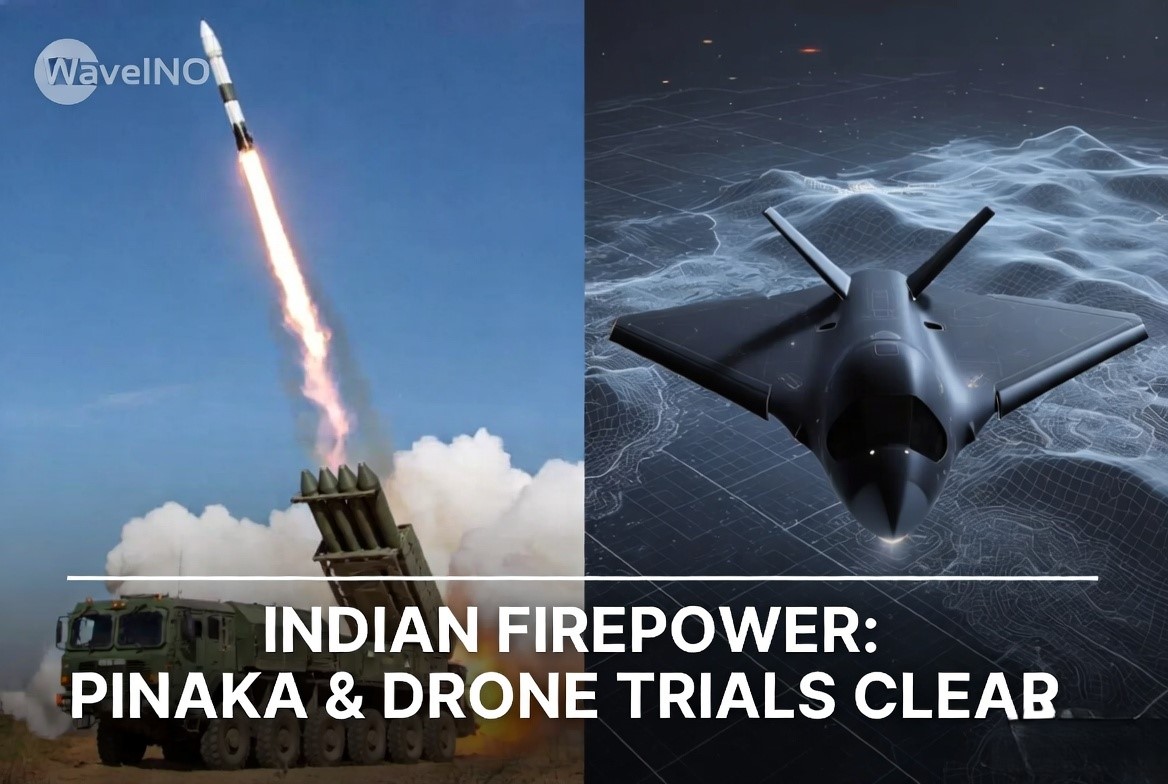
CHANDIPUR — In a major breakthrough aimed at securing frontline artillery dominance and neutralizing electronic warfare threats across contested borders, India’s defense ecosystem successfully validated multiple indigenous strike and defense assets. The Defence Research and Development Organisation, in active coordination with the Indian Army, conducted a flawless flight test of the Pinaka Long Range Guided Rocket from the Integrated Test Range at Chandipur off the Odisha coast. The highly specialized trial focused specifically on proving the rocket's user-defined minimum strike range of 60 kilometers, ensuring that the heavy artillery asset leaves absolutely no "dead zones" for defensive batteries on the battlefield.
According to formal statements from the Ministry of Defence, the high-velocity rocket was launched directly from an in-service standard Pinaka multi-barrel launcher. The weapon executed complex, pre-programmed in-flight maneuvers to shed excessive propulsion energy before plunging down with textbook precision onto its designated sea-skimming target. Defense experts emphasize that making a long-range weapon maneuver sharply to hit a much closer target requires advanced guidance algorithms, proving the high-tier maturity of India's indigenous navigation frameworks.
Zero Dead Zones and Multi-Range Versatility
The success of Wednesday's minimum-range evaluation is considered a vital milestone following the maximum 120-kilometer range trial executed late last year. In conventional warfare settings, artillery regiments often encounter operational limitations where a long-range missile or rocket cannot engage targets that accidentally break through inner tactical zones. By engineering a singular rocket variant capable of covering the entire 60-to-120-kilometer tactical envelope, the Indian Army can now deploy unified launch batteries without investing in multiple short-range infrastructure setups.
The Armament Research and Development Establishment designed this guided variant in close collaboration with the High Energy Materials Research Laboratory and the Research Centre Imarat. The capability to fire multi-range projectiles out of the exact same launcher gives field commanders immediate operational flexibility to destroy incoming enemy armored columns, communication outposts, and localized radars simultaneously.
Horus Vinashaka and Skyrun Ares: Signal Defense Integration
Alongside the heavy artillery triumphs, parallel operational evaluation matrices are reshaping India's tactical drone capabilities and electronic countermeasures. Private and public sector collaborative programs have accelerated structural testing schedules for advanced signal protection setups. A central highlight includes the strategic refinement of the Horus Vinashaka-60, an indigenous long-range autonomous kamikaze drone engineered by domestic aerospace startup networks.
The Vinashaka platform features a 15-kilogram strike payload capacity with an impressive operational range touching 550 kilometers. Powered by localized fuel engines, it offers up to eight hours of combat endurance. Crucially, the latest test reports confirm the integration of highly resilient GNSS-assisted navigation coupled with specialized Inertial Navigation Systems (INS). This protective combination ensures the loitering munition remains entirely unaffected by heavy electronic jamming or localized signal-spoofing attempts executed by enemy systems.
Simultaneously, tactical communication nodes are observing accelerated structural updates through advanced field trials. Ground units are implementing modernized digital shielding frameworks to securely insulate battlefield data sharing from foreign interceptors. Defense integration agencies are aggressively mapping these secure signal pathways alongside tactical tracking arrays to build a cohesive, jam-proof matrix for multi-domain operations.
Achieving Complete Atmanirbharta in Precision Warfare
Following the successful completion of the Pinaka flight trial, Raksha Mantri Rajnath Singh formally extended his congratulations to the DRDO scientist cohorts, private manufacturing partners, and the Indian Army units involved in the deployment. The Defense Minister categorized the textbook impact as a defining moment for self-reliance in high-precision guided weaponry.
As global conflicts continue to show that electronic signal manipulation and long-range tactical artillery determine frontline success, India's simultaneous progress across multi-range rocket batteries, resilient automated drones, and secure digital signal platforms highlights a rapid transition toward a highly modernized, independent national defense architecture.