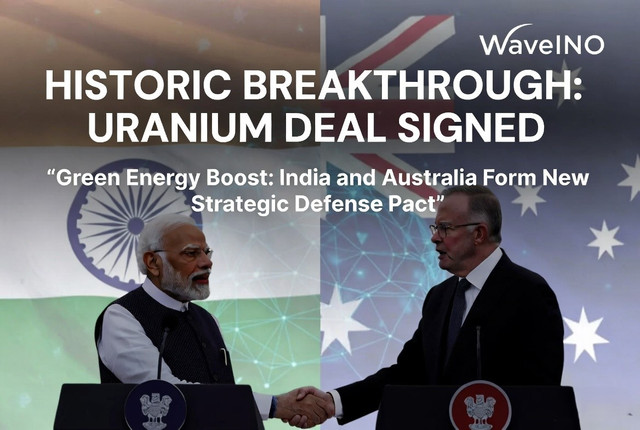
MELBOURNE — In a major diplomatic breakthrough that is set to redefine Asia-Pacific trade and energy dynamics, India and Australia have officially finalized the administrative arrangements required to execute direct commercial exports of Australian uranium to Indian nuclear installations. The historic nuclear energy pact was formalized on Thursday during the 3rd India-Australia Annual Summit held at the Government House in Melbourne. Prime Minister Narendra Modi, who is currently on a high-profile bilateral visit to the country, joined his Australian counterpart Anthony Albanese to witness the exchange of multiple bilateral memorandums aimed at securing critical supply chains.
The newly signed deal marks a massive transition in regional cooperation, especially considering Australia’s historical hesitation regarding shipping radioactive raw materials to non-signatories of the Nuclear Non-Proliferation Treaty. Addressing a packed joint press conference, Prime Minister Modi emphasized that the uranium supply pipeline provides immediate momentum to India’s long-term clean energy roadmaps, which target a monumental 100 gigawatts of active nuclear power capacity by the year 2047.
Diversifying Energy to Meet Aggressive Clean Power Milestones
India currently depends heavily on thermal coal setups to sustain its industrial growth, but under its global climate commitments, the country is rapidly trying to shift at least half of its cumulative power requirements to non-fossil alternatives. Australia holds approximately 28% of the planet's identified uranium reserves, making it the most critical logical partner for India's domestic energy transformation. Government analysts note that the incoming supplies will be strictly bound under the formal safeguard mechanisms established by the International Atomic Energy Agency, ensuring the resource is utilized exclusively for civilian and peaceful power production.
Prime Minister Anthony Albanese echoed this sentiment, noting that diversifying trading channels beyond existing regional monoliths like China remains a priority for Canberra. By integrating Australian raw minerals directly into India's rapidly growing electricity grid, both economies stand to secure heavy economic insulation against sudden global energy fluctuations.
Deepening Defense and Space Infrastructure Ties
Beyond the nuclear agreement, the Melbourne summit delivered a major structural update to the bilateral strategic framework. The two leaders adopted a new Joint Declaration on Defence and Security Cooperation. This updated mandate outlines an aggressive schedule for joint naval exercises, expanded maritime surveillance tracking, and co-development ventures within defense industrial corridors. Amid rising geostrategic uncertainty across the Indo-Pacific waters, the joint declaration sends a loud, clear message regarding a shared commitment to keeping vital sea lanes free, open, and rules-based.
Furthermore, the scientific agencies of both nations announced plans to build a temporary space tracking terminal on Australia's strategically located Cocos Keeling Islands in the Indian Ocean. This specialized tracking installation will offer critical ground-station support to upcoming Indian space flight projects and manned satellite missions, showcasing a deep administrative trust that now spans from the deep ocean floor to outer space.
Corporate Investments and Cricket Diplomacy
The financial dimensions of the visit were amplified by Union Finance Minister Nirmala Sitharaman’s announcement in New Delhi, confirming that Australia’s largest pension fund, AustralianSuper, is deepening its institutional commitment to the National Investment and Infrastructure Fund. The group is infusing an additional 500 million Australian dollars into Indian developmental assets, pushing its total cumulative footprint across Indian markets to a staggering 3.3 billion Australian dollars.
Concluding his public itinerary on Thursday evening, Prime Minister Modi attended a vibrant diaspora event alongside Albanese, playfully leaning into the shared cultural love for cricket to define the changing pace of bilateral relations. Comparing past strategic efforts to slow-paced test matches, Modi remarked that the modern partnership operates with the aggressive, high-scoring momentum of a modern T20 match, where both nations are scoring boundaries together across trade, tech, and security fields alike.