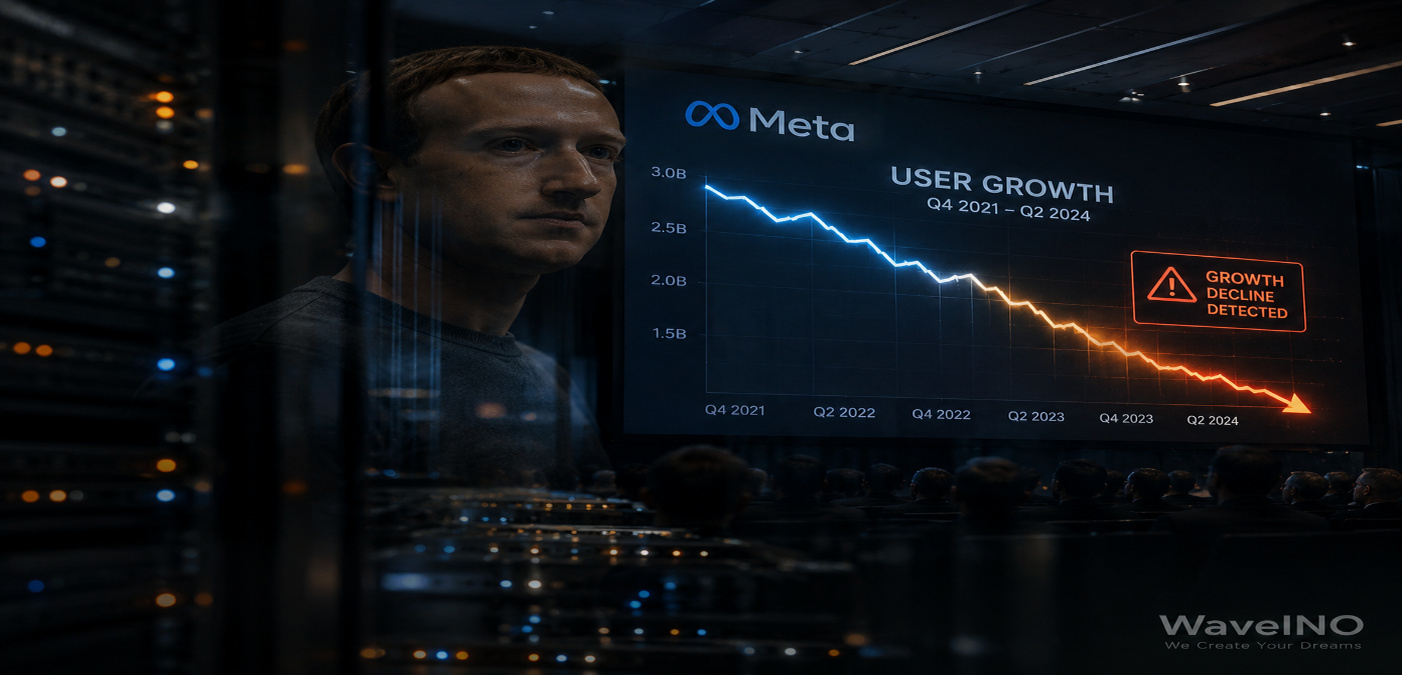
For the past eighteen months, Silicon Valley has operated under a single, unyielding directive: pour billions into data centers, recruit every machine learning engineer in sight, and sprint toward "agentic AI"—autonomous systems capable of handling multi-step workflows without constant human prompting. However, the aggressive timeline driving this generational tech shift has just encountered a massive internal reality check from one of its primary orchestrators.
During an internal town hall meeting with Meta employees, Chief Executive Mark Zuckerberg delivered an unusually frank assessment of the company's core technological focus. According to internal audio leaks, Zuckerberg conceded that the trajectory of Meta's AI agent development over the past four months has simply not accelerated in the way executives aggressively forecasted when the year began.
The Disconnect: $145 Billion in Compute vs. Stalled Progress
What makes Zuckerberg's admission particularly striking is the sheer scale of the financial and human capital Meta has deployed to chase this technological acceleration. The social media giant is currently projected to allocate up to $145 billion toward AI infrastructure this year alone. This massive capital expenditure forms a substantial slice of the broader tech sector's staggering $700 billion aggregate infrastructure outlay.
Yet, as Zuckerberg candidly shared with his workforce, the massive upfront investments in raw computing power have not translated into immediate software breakthroughs. The CEO noted that during planning sessions in January and February, executives were "super optimistic" about the rapid evolution of cutting-edge programming tools like Anthropic's Claude Code. The internal expectation was that these advancements would rapidly compound, creating a wave of highly advanced, autonomous agents ready to deploy across Instagram, WhatsApp, and Facebook.
Instead, Zuckerberg acknowledged that those high-conviction structural bets "haven’t come to fruition yet," marking a rare moment where a Big Tech pioneer admitted that raw computational scale cannot automatically force code to evolve faster than humanly possible.
A Turbulent Restructuring and the "Less Than Clean" Workforce Shift
The internal friction at Meta isn't merely algorithmic; it is deeply organizational. To fuel this massive pivot toward artificial intelligence, Meta executed a disruptive restructuring wave that culminated in cutting roughly 10% of its global workforce (approximately 8,000 jobs). Simultaneously, the company executed a massive, high-pressure human reallocation, shifting 7,000 corporate employees into specialized AI-focused engineering teams virtually overnight.
[Image outlining the enterprise architectural challenges of autonomous AI agents]
Addressing the fallout from these aggressive movements, Zuckerberg admitted to staff that the workforce transformation was "not as clean" as it could have been. He revealed that the sheer speed and timing of the layoffs and internal reassignments were heavily driven by corporate panic—a deeply rooted fear among top leadership that Meta "weren't going to move fast enough to adapt" to the competitive threat vectors posed by OpenAI, Google, and Microsoft.
This rapid, top-down integration has taken a visible toll on corporate culture. Engineers inside the company's newly consolidated Applied AI units have described punishing, unsustainable working environments as teams try to bridge the gap between abstract corporate expectations and the hard, complex realities of autonomous software engineering.
What Lies Ahead: A Three to Six Month Window
Despite the immediate setbacks and cultural friction, Zuckerberg stopped short of sounding a full-scale retreat. He maintained a characteristically forward-looking stance, telling employees that he fully expects Meta to begin experiencing "more significant benefits" from its monumental infrastructure investments within the next three to six months.
Simultaneously, Meta is attempting to diversify its massive computing exposure. Reports have surfaced indicating that the company is actively planning to build an enterprise cloud business, designed to lease out its excess AI computing capacity to third-party developers. This strategic pivot heavily implies that Meta is building a crucial financial safety valve in case consumer-facing AI features fail to generate enough direct revenue to justify the massive, ongoing infrastructure overhead.
Ultimately, Meta’s internal admission serves as a vital case study for the entire technology ecosystem. Autonomous AI agents remain the undisputed holy grail of the current tech cycle, but as Meta is discovering, writing the future of software requires far more than just signing massive checks for microchips.