Quick answer: A robust B2B service cancellation and refund workflow replaces subjective client arguments with objective, pre-agreed milestone acceptance gates, formal change request (CR) procedures, and pro-rata financial settlement rules. Under Sections 73 and 74 of the Indian Contract Act, 1872, agencies and service providers can retain earned milestone payments and pre-estimated liquidated damages for work completed, provided contracts clearly establish stage-gate sign-offs, deemed acceptance windows (typically 7 to 10 business days), and automated payment gateway refund reconciliation.
When a B2B project goes off track—whether due to client leadership turnover, budget cuts, strategic pivots, or misaligned expectations—the lack of an explicit cancellation framework creates immediate friction. Clients demand a full refund for unfinished software or marketing retainers, while agencies face unrecoverable developer labor costs, unpaid milestone invoices, and disputed intellectual property ownership. Establishing structured milestone acceptance protocols protects both parties and eliminates costly legal disputes.
1. Why Standard Service Contracts Fail During Project Off-Ramps
Most service disputes do not happen because either party acted in bad faith. They happen because standard Master Services Agreements (MSAs) and Statements of Work (SOWs) suffer from four structural vulnerabilities:
- Subjective Completion Criteria: SOWs frequently state vague milestones such as "completion of design phase" or "backend architecture setup" without measurable acceptance tests, allowing clients to reject completed work based on moving aesthetic goalposts.
- Unregulated Scope Creep: Informal requests made via Slack, email, or WhatsApp get merged into the current milestone without adjusting the delivery timeline or fee schedule. When the project inevitably misses its original deadline, the client claims breach of contract.
- Unspecified Review Deadlines: When a client takes 45 days to review a prototype, agency engineering capacity sits idle or gets reassigned. Without deemed acceptance clauses, projects stall indefinitely without billing milestones being unlocked.
- Binary "All-or-Nothing" Refund Demands: Without explicit pro-rata valuation rules, a client terminating a $20,000 web application build at Phase 3 often demands a 100% refund, disregarding hundreds of hours of completed discovery, system architecture, and UI design.
2. The 5-Stage Objective Milestone Acceptance Framework
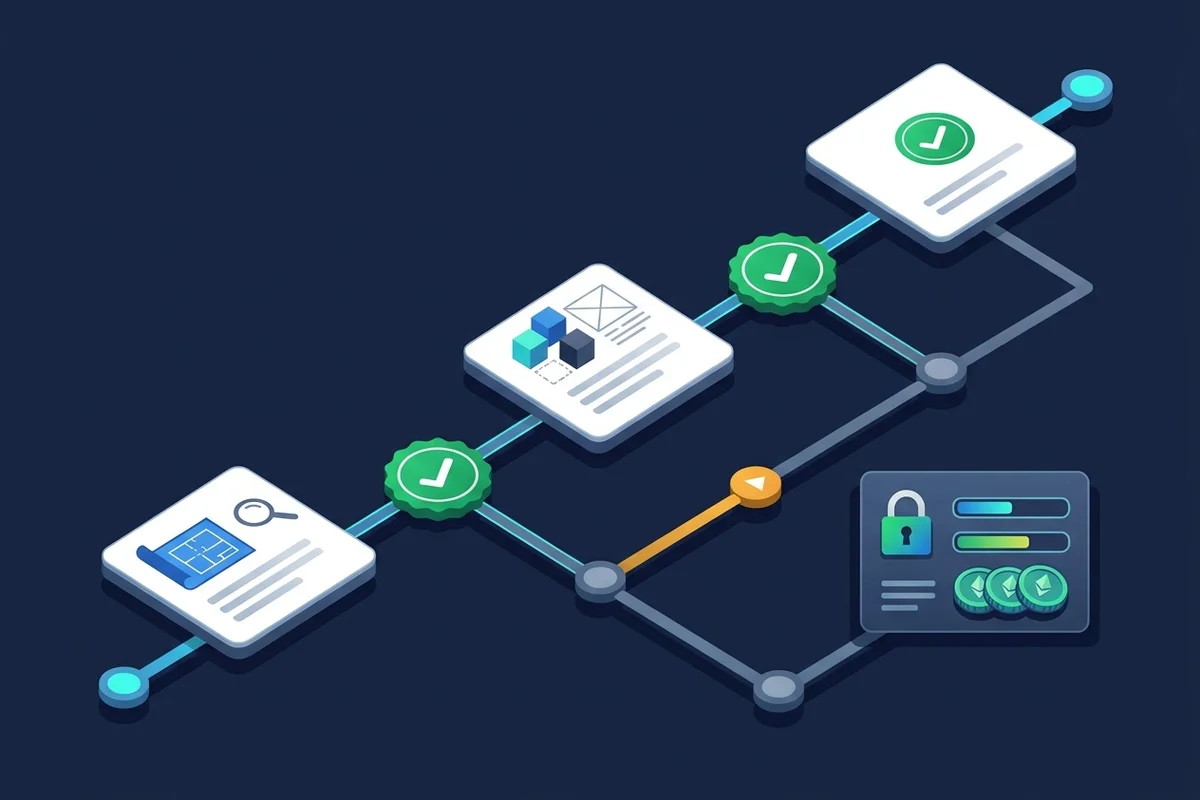
To eliminate ambiguity, every commercial contract engineered at WaveINO Web Development anchors project compensation to a structured 5-stage acceptance framework with explicit sign-off gates:
| Project Stage | Tangible Deliverables | Objective Verification Criteria | Payment Tranche | Review Window |
|---|---|---|---|---|
| 1. Discovery & Architecture | Technical Specification Document (TSD), User Journey Maps, Database Schema, Third-Party API Audit | Mutual sign-off on TSD and database entity-relationship (ER) diagram; security and compliance review | 20% Initial Deposit (Non-refundable) | 5 Business Days |
| 2. Wireframes & UI/UX Design | Figma component library, responsive desktop/mobile wireframes, interactive prototype | Completion of 2 designated feedback rounds; written approval on all primary viewport templates | 25% Milestone 2 | 7 Business Days |
| 3. Core Development & API Integration | Dockerized container builds, REST/GraphQL endpoints, database migrations, staging deployment | Passing automated unit/integration test suite; staging server walkthrough with zero Critical defects | 30% Milestone 3 | 10 Business Days |
| 4. User Acceptance Testing (UAT) | Staging release, end-to-end integration walkthrough, speed/performance benchmarks | Resolution of all Severity 1 (Blocker) and Severity 2 (Major) logged bugs against original SOW criteria | 15% Milestone 4 | 10 Business Days |
| 5. Production Launch & Handover | DNS propagation, SSL installation, production database seeding, Git repo transfer, admin training | Live HTTP 200 checks, error-free production telemetry for 72 hours, admin documentation delivery | 10% Final Release | 3 Business Days |
3. Deemed Acceptance and Defect Severity Protocols
A critical clause in any modern B2B agreement is the Deemed Acceptance Protocol. When deliverables are submitted for client review, the contractual review timer begins immediately.
"If the Client fails to deliver a written, consolidated list of non-conformities within the designated Review Window, the Deliverable shall be deemed accepted in full, unlocking the corresponding milestone invoice and authorizing the Service Provider to proceed to the subsequent development stage."
Furthermore, client review feedback must be categorized using objective defect classification rather than subjective dissatisfaction:
- Severity 1 (Blocker): A core workflow is entirely inoperable (e.g., payment webhook fails or authentication throws a 500 error). Blocks milestone sign-off; agency must remedy within 3 to 5 business days.
- Severity 2 (Major): A primary feature operates with workarounds or performance lags (e.g., search filter sluggishness). Addressed within current milestone sprint before sign-off.
- Severity 3 (Minor / Aesthetic): Minor styling discrepancy, font padding inconsistency, or non-blocking copy change. Does not block milestone acceptance or payment release; resolved in subsequent polish sprint.
- Out-of-Scope Request: Any request introducing a capability not explicitly listed in the Statement of Work. Automatically converted to a formal Scope Change Request.
4. Managing Scope Creep: The Scope Change Request (CR) Protocol
Scope creep is the single most common trigger for B2B contract cancellations. When a client requests modifications mid-stream, never accept verbal or chat confirmations. Channel every modification through a formal Change Request (CR) workflow:
- Submission: The client or agency project manager logs the requested modification with user stories and business justification.
- Technical & Cost Impact Assessment: Engineering evaluates the architectural impact, estimating required hours, third-party licensing additions, and schedule timeline shift.
- CR Addendum Issuance: A written addendum is generated specifying:
- Exact delta in deliverables
- Additional fees (fixed price or hourly T&M rate)
- New delivery deadlines across all subsequent milestones
- Execution Gate: Development on the requested modification does not begin until the client signs the CR addendum and remits any required deposit. If rejected, the project proceeds strictly under the original SOW parameters.
5. Cancellation and Dispute Resolution Decision Matrix
When project termination is unavoidable, applying a standardized cancellation matrix prevents emotional negotiations and ensures statutory compliance under Sections 73 and 74 of the Indian Contract Act, 1872:
| Cancellation Scenario | Triggering Event | Financial Settlement Rule | Intellectual Property (IP) Release | Statutory Legal Ground |
|---|---|---|---|---|
| Termination for Convenience (Client) | Client pivots business model or cancels project without agency default. | Agency retains all completed milestone fees + 50% kill fee of current in-progress phase to cover allocated team capacity. | Full IP assignment granted only for completed and paid milestones; unbuilt assets remain agency property. | Section 74: Liquidated damages representing genuine pre-estimate of unmitigated booking loss. |
| Termination for Cause (Agency Default) | Agency fails to remedy verified Severity 1 defects within the 14-day cure period. | Full refund of current disputed milestone tranche; agency retains payments for previously signed-off milestones. | Client receives all working code and design files produced up to the last approved milestone. | Section 73: Compensation for direct breach; exclusion of remote or speculative damages. |
| Termination for Client Default (Payment Failure) | Client fails to pay milestone invoice within 15 calendar days of due date. | Immediate suspension of services; retention of all deposits and late fee interest; forfeiture of staging access. | Zero IP transfer; all code repositories, staging servers, and visual assets remain withheld until full settlement. | Right of lien and damages for breach under Section 73 of Indian Contract Act. |
| Mutual No-Fault Termination | External force majeure, fundamental API deprecation, or agreed impasse. | Pro-rata accounting: unearned advance deposit refunded; client billed for actual logged hours on in-progress phase. | Working artifacts handed over "as-is" without warranty upon account zero-balance clearance. | Section 65: Obligation of person who has received advantage under void or terminated agreement. |
6. Financial Mechanics: Automated Partial Refunds and Accounting
When issuing negotiated settlements or partial refunds, agencies must maintain complete transactional provenance to prevent chargeback claims and satisfy tax reporting requirements:
- Automated Partial Refund Processing: Rather than issuing manual bank transfers that break financial CRM reconciliation, utilize the Razorpay Refunds API to execute partial refunds against the original payment capture ID (
amount_refundedparameter), ensuring instantaneous return to the client's source account while updating your ledger automatically viarefund.processedwebhooks. - Credit Notes for GST Compliance: Under Indian GST regulations, issuing a refund requires generating a formal GST Credit Note against the original commercial tax invoice within the prescribed statutory period, adjusting tax liability accordingly.
- Settlement and Release Agreement: Never disburse refund capital without a signed Mutual Release and Non-Disparagement Agreement. The agreement must formally extinguish all future claims, require deletion of confidential material, and state that the refund constitutes full and final satisfaction of all liabilities.
For high-velocity service businesses, tying payment gateway webhooks directly to CRM deal pipelines ensures that billing statuses, contract milestones, and customer success notifications stay perfectly synchronized. Explore our guides on CRM duplicate contact rules and CRM lead follow-up automation to streamline client onboarding and pipeline management.
Frequently Asked Questions (FAQs)
Can a B2B client legally demand a 100% refund after discovery and prototyping?
No, provided the contract features milestone-based deliverables and a non-refundable discovery phase deposit. Under Section 73 of the Indian Contract Act, 1872, an agency is entitled to compensation for actual time, labor, and resources expended. When an agency delivers agreed discovery blueprints, architecture plans, or wireframes, the client has received value and cannot legally demand the return of earned milestone compensation.
What is "Deemed Acceptance" in software and digital agency service agreements?
Deemed acceptance is a contractual provision stating that if a client fails to provide written objections or defect reports within a specified timeframe (typically 7 to 10 business days after delivery), the milestone is legally recognized as accepted. This prevents indefinite project stalls and authorizes the service provider to issue invoices and move to subsequent development stages.
How do Sections 73 and 74 of the Indian Contract Act apply to service cancellations?
Section 73 governs unliquidated damages, requiring the injured party to prove direct financial loss caused by a contract breach while excluding remote or speculative losses. Section 74 governs liquidated damages and penalty clauses, allowing the aggrieved party to receive reasonable compensation up to the agreed contract cap without needing to calculate every minute expense, provided the sum represents a genuine pre-estimate of loss rather than an unconscionable penalty.
When is intellectual property (IP) transferred in a cancelled project?
In standard professional service agreements, intellectual property ownership (source code, Figma assets, database configurations) transfers only upon receipt of full payment for the relevant milestone. If a project is cancelled mid-way, the client receives IP rights only for the milestones they have completely paid for, while unbuilt code and in-progress proprietary components remain the agency's exclusive property.
How should agencies process partial refunds in modern payment gateways?
Agencies should use the payment gateway's programmatic refund endpoint (such as Razorpay's Partial Refund API with speed_requested: "optimum") passing the original transaction ID and the exact refund amount. Listening to server-side webhook events like refund.processed and refund.failed guarantees that your ERP or CRM records reflect real-time settlement without manual ledger discrepancies.