What this guide covers: Compare AI coding models using dated Arena results, then test debugging, repository edits, tests, security and the cost of accepted code.
Updated 12 October 2026. The best AI coding model is the one that reliably helps your team ship maintainable, verified changes. October 2026 leaderboards provide useful evidence, but they do not replace testing with your real framework, tools and repository.
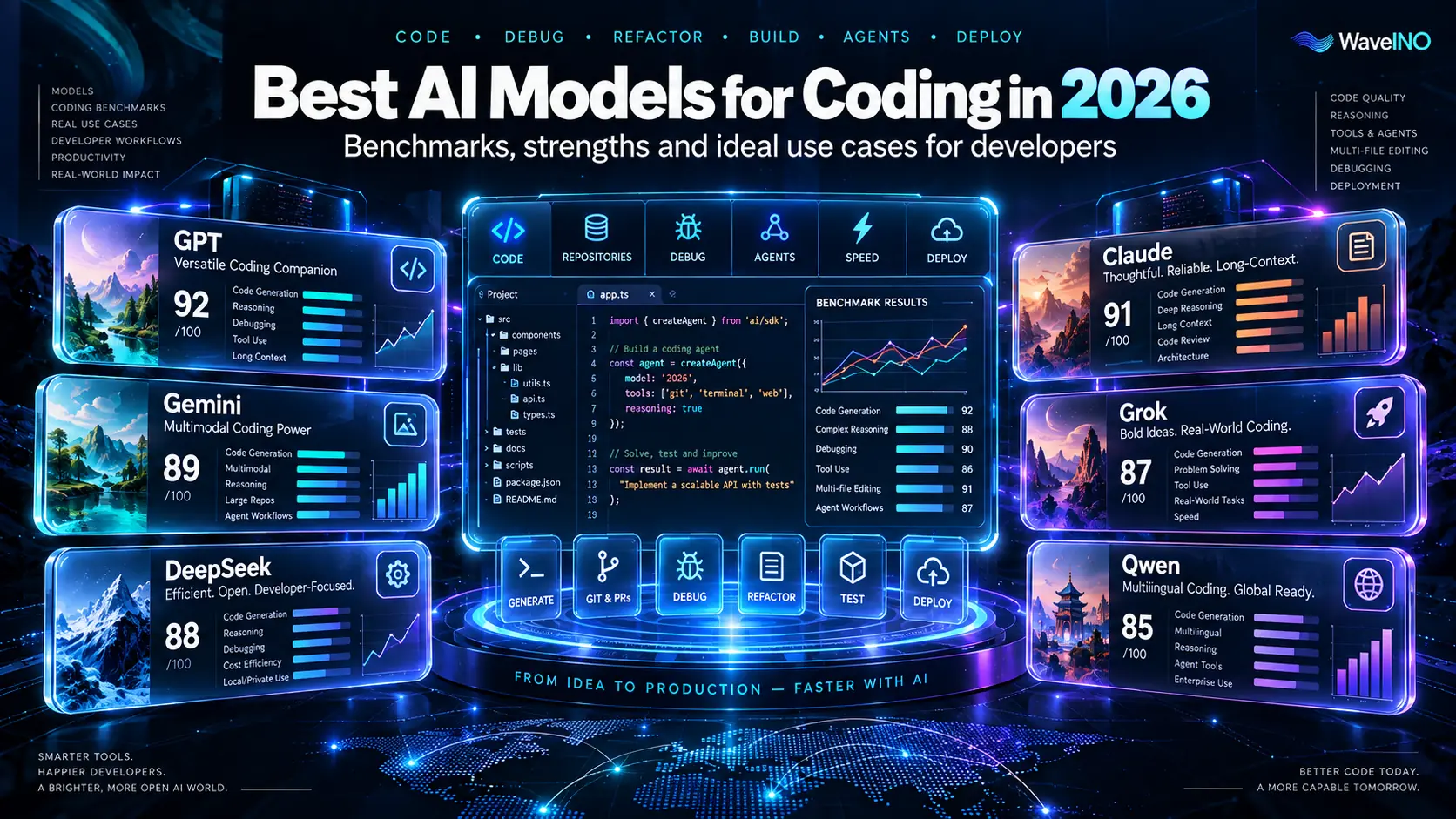
Editorial transparency: A leaderboard score depends on the exact model variant, evaluation date, prompt mix, sampling and test rules. Figures printed inside the creative cover are decorative, not verified performance measurements. We use independent benchmark snapshots where possible and do not award a fictional overall percentage.
What does a coding benchmark measure?
Code-completion tests, human-preference contests, repository repair and terminal-agent challenges reward different abilities. A model that writes a polished example may fail when asked to edit five related files in a production repository. A successful patch also needs tests, security review and maintainability.
The evaluation environment matters. A model may be allowed a compiler, browser, shell or test runner; another may be scored from one answer alone. Teams should compare the same tools and execution limits rather than selecting from disconnected marketing charts.
Coding leaderboard snapshot: 8 October 2026
The Arena Coding leaderboard showed Gemini 4 Argon High at 1562 ± 17 with 1,233 votes, marked preliminary, followed by Claude Fable 5 High at 1551 ± 7 with 10,404 votes. Claude Opus 4.7 High, Claude Opus 4.6 High and Claude Opus 5.5 High clustered around 1550 on that displayed snapshot.
These are human-preference ratings. Close scores and overlapping rank spreads do not mean one model will necessarily fix more real bugs. The listing also covers many configuration-specific versions, so always save the complete model identifier.
Agentic coding is a different challenge
Artificial Analysis Index v4.3 incorporated Terminal-Bench 4.0 and SciCode into its multi-part evaluation. Terminal work can involve command execution and debugging; scientific coding can demand more precise reasoning. Use agentic benchmark results when choosing a model that will run tools, but still check how tests were conducted.
An internal benchmark should include a representative broken endpoint, a performance regression, a dependency upgrade and a small feature addition. Evaluate patch correctness and whether the assistant respects the repository’s conventions.
What about open-weight coding models?
Arena maintains a coding leaderboard filtered by open licenses. The October 8 snapshot included MiMo v2.6 Pro, Kimi K3 Max, GLM 5.3 Flash and DeepSeek V4.1 Flash variants among notable high-performing choices in the filtered view.
Open-weight does not automatically mean unrestricted commercial use or effortless on-premises deployment. Read the exact license, hardware requirements and operational responsibilities. For a private codebase, include data retention, auditability and network boundaries in the selection.
A real developer evaluation should include these tasks
Ask each model to understand an existing repository, write a failing test, explain the cause, propose a minimal patch and run tests. Include multi-file changes and intentionally ambiguous requirements. Reject solutions that silently suppress failing assertions or disable security checks.
Track time to accepted pull request, reviewer edits, test failures, accidental file changes and total API/tool cost. A fast first draft that requires hours of debugging is not necessarily productive. Compare models on exactly the same code snapshot.
Deploy with human ownership and verification
Do not give a coding agent unrestricted production credentials or permission to merge without review. Use a staging environment, least-privilege tokens, approvals for destructive actions and a rollback plan. See WaveINO’s human approval workflow guide and chatbot handoff checklist for practical deployment controls.
Start with narrow repetitive engineering chores before broad autonomous changes. After a model update, rerun your team’s test suite and sample the generated code for correctness and security.
Frequently asked questions
Is a coding Arena score the same as real repository performance?
No. Coding preference and actual tested patches measure different outcomes; evaluate both.
Can open-weight models code well?
Yes, several are competitive in coding filters, but the right choice depends on license, deployment cost, tooling and your codebase.
Which metric matters for developers?
Use time to a reviewed, test-passing change, including human repair work and total cost.
Should AI deploy generated code automatically?
Apply least privilege, CI tests, code review and staging before production changes.
Sources and benchmark methodology
- Arena Coding leaderboard (8 Oct 2026)
- Arena coding leaderboard, open-weight/license filter
- Artificial Analysis Intelligence Index v4.3 methodology and results
- OWASP AI Agent security considerations
For help choosing or integrating a model into an Indian business website or workflow, contact WaveINO. See WaveINO’s human approval workflow guide and chatbot handoff checklist for practical deployment controls.