What this guide covers: Compare multimodal AI for images, documents, audio and video with dated vision benchmarks and practical business tests.
Updated 12 October 2026. As AI systems expand beyond text, the phrase “best multimodal model” can be misleading. The useful question is whether a specific model reliably handles your images, audio, video and document workflows.
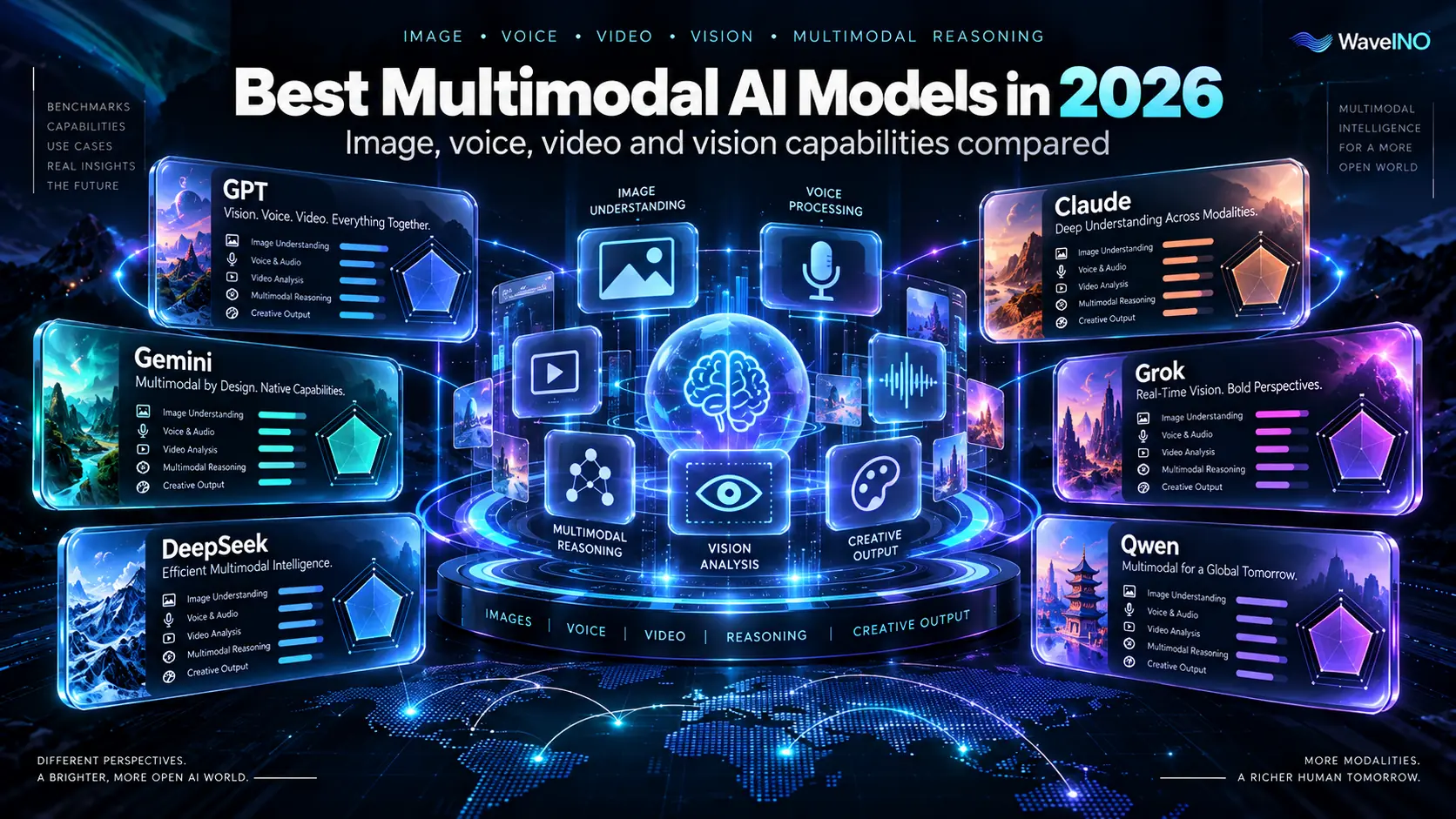
Editorial transparency: A leaderboard score depends on the exact model variant, evaluation date, prompt mix, sampling and test rules. Figures printed inside the creative cover are decorative, not verified performance measurements. We use independent benchmark snapshots where possible and do not award a fictional overall percentage.
Multimodal AI is not one single benchmark
A multimodal system may read an image, analyze a chart, transcribe audio, summarize video or generate a new visual. Input understanding and media generation are separate capabilities. A model that reasons well about photographs may not offer direct audio input or video generation through the API version your team uses.
The correct comparison names the task, modality and model interface. Test visual reasoning separately from image creation, speech transcription and video output, including relevant consent and safety requirements.
Vision Arena snapshot: 9 October 2026
On the Arena Vision overall leaderboard dated 9 October 2026, Claude Fable 5 High was listed at 1308 ± 7 with 14,175 votes, Qwen3.8 Max at 1301 ± 7 with 10,017 votes and Claude Opus 4.6 High at 1299 ± 6. Gemini 3.7 Flash High appeared within the leading group but was marked preliminary.
These are human-preference scores for visual input tasks, not percentages of correct image answers. They do not, by themselves, rank speech recognition, image generation or video-production quality. Different visual subtasks such as diagram interpretation and text recognition can change the ordering.
How six major model families may enter a shortlist
Consider GPT, Claude, Gemini, Grok, DeepSeek and Qwen families as candidates with different product configurations, interface support and deployment constraints. Do not assume every model within a brand has identical multimodal abilities. An image-capable variant in one family may coexist with text-only variants or separate image-generation products.
A team analyzing complex PDFs can prioritize chart and diagram interpretation, while a sales team processing voice enquiries needs transcript accuracy, language support and reliable customer escalation. Check official documentation for the exact endpoint, supported file size and privacy policy before implementation.
Vision tasks to test in a real business
Useful test cases include reading a delivery invoice, extracting fields from a product photo, comparing screenshots for a UI bug, identifying a chart trend and locating errors on a scanned form. Include difficult lighting, mixed Hindi-English text and blurred image examples where relevant to customers.
Score data extraction field by field, including dates and currency symbols. Test whether the system says “cannot read” instead of inventing a number. When a photograph depicts real people, minimize exposure of personal information and avoid unsupported identity conclusions.
Audio and video need separate tests
Speech systems must be evaluated on noisy recordings, accents, language switching, speaker turns and incomplete audio. Video summarization involves time alignment and may need to inspect representative frames rather than assume every action was perceived. Measure transcript error, timestamp accuracy and false claims separately.
For outbound generated media, review copyright, consent, disclosure, brand accuracy and platform terms. A beautiful demo clip is not evidence of acceptable performance on real customer assets or of permission to process those assets.
Build multimodal systems with verification
Start with one narrow workflow such as invoice extraction with human review or image-assisted product cataloging. Limit file permissions, scan uploads and retain originals securely. Route low-confidence results to staff and preserve a trace from each output field to its source.
Track the real cost of preprocessing, retries, human checking and storage. The strongest multimodal business solution often combines multiple components rather than relying on one model for everything.
Frequently asked questions
Does the best vision model also generate the best images?
No. Vision understanding and image generation are separate tasks with separate quality and safety evaluations.
Are the on-image ratings and token limits verified?
No. Those visual annotations are conceptual artwork; use the dated source-linked benchmark figures in the article.
Can a model read invoices and scanned documents accurately?
It may help, but test field-level accuracy and require validation before posting financial data.
What should Indian teams test first?
Use representative phone photos, local language text, noisy audio and real business document layouts while respecting consent.
Sources and benchmark methodology
- Arena Vision leaderboard (9 Oct 2026)
- Arena Text Overall leaderboard (8 Oct 2026)
- OpenAI GPT-6 launch (7 Oct 2026)
For help choosing or integrating a model into an Indian business website or workflow, contact WaveINO. See WaveINO’s human approval workflow guide and chatbot handoff checklist for practical deployment controls.