What this guide covers: Use a practical scorecard to select AI for coding, research, chat, sales and automation based on quality, privacy and total task cost.
Updated 12 October 2026. Choosing the right AI model is a procurement and systems-design decision, not a popularity contest. This framework helps Indian businesses connect model selection to real outcomes, risk controls and measurable cost.
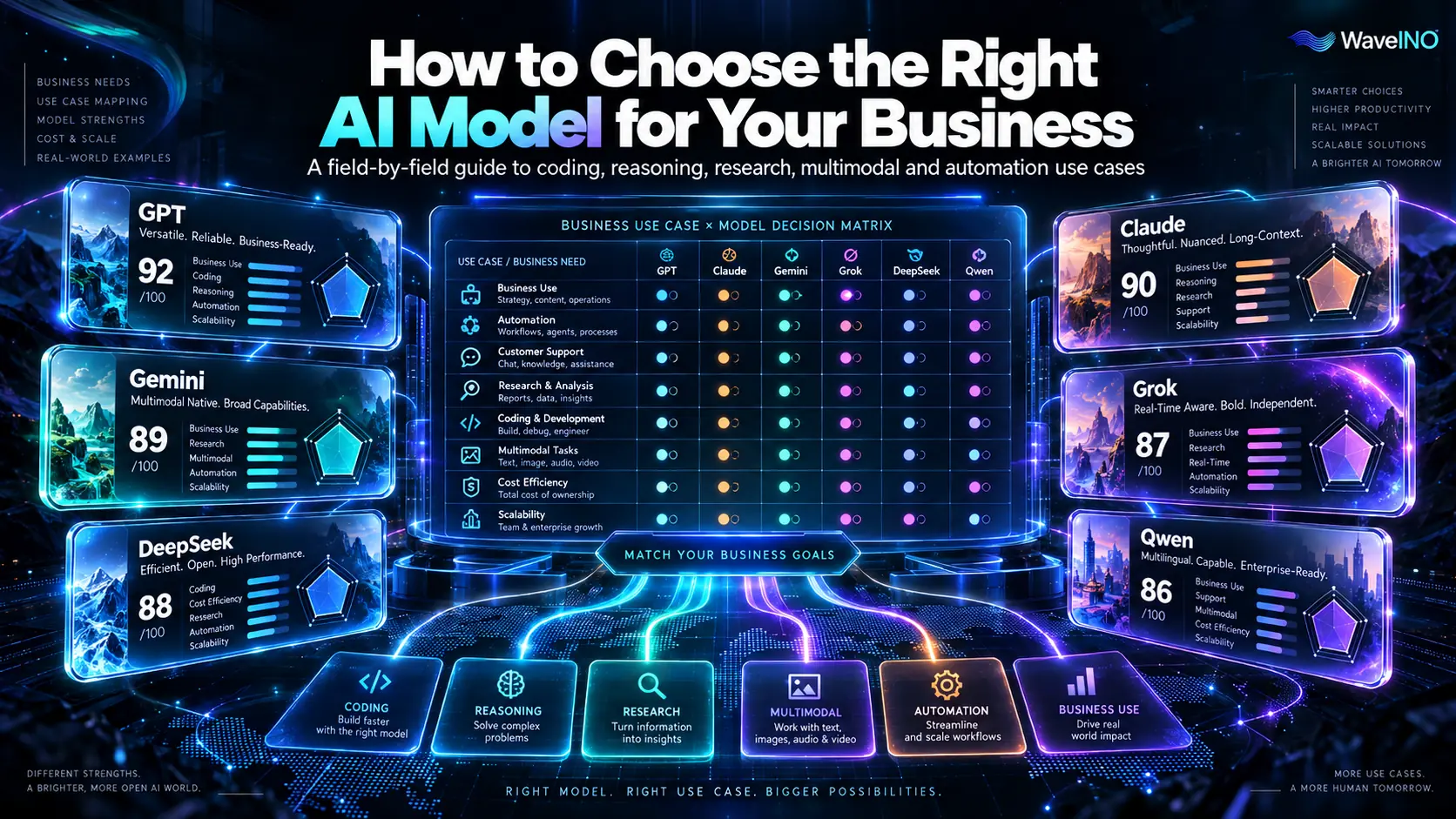
Editorial transparency: A leaderboard score depends on the exact model variant, evaluation date, prompt mix, sampling and test rules. Figures printed inside the creative cover are decorative, not verified performance measurements. We use independent benchmark snapshots where possible and do not award a fictional overall percentage.
Start with the business outcome, not the model brand
A company may want shorter response times to enquiries, more accurate reporting, faster software development or dependable document processing. Each problem needs different data, permissions and measures of success. Buying the largest model without a defined task creates unnecessary cost and risk.
Write the workflow in plain terms: what goes in, what correct output looks like, who checks the result and what happens when the model is wrong. Decide whether the system merely advises a staff member or takes an external action.
Build a model shortlist by capability and deployment fit
For high-effort reasoning and general work, compare currently available GPT, Claude and Gemini variants. Add Grok, Qwen, DeepSeek and other competitive alternatives where language requirements, licenses, cost or hosting preferences justify it. Treat model families as starting points, not a fixed quality ranking.
Use Arena to understand user preference and Artificial Analysis for mixed task evaluations and cost-per-task methodology. A model’s overall leaderboard rank is not proof that it fits a CRM, a support desk or an internal codebase.
A practical weighted business scorecard
Before testing, assign weights to requirements. For example, a hypothetical customer-support rollout might use 35% factual answer accuracy, 20% successful human escalation, 15% Hindi-English handling, 15% privacy and access controls, 10% latency and 5% operating cost. These weights are an illustrative business decision, not a published AI benchmark.
Choose weights around the cost of a failure. A finance reporting assistant might weight correctness and auditability much higher. A creative brainstorming assistant may place more emphasis on usefulness, diversity and iteration speed.
Compare cost per accepted outcome
API token price is a starting point, but the real budget also includes retrieval, tools, model retries, long-context input, infrastructure, monitoring and review time. Measure a successfully completed and accepted business task from end to end.
A cheaper model may cost more if staff continually repair outputs. Conversely, a high-end model can be wasteful for classification or simple routing that a small model handles reliably. A staged pipeline using different models for different steps may offer better overall value.
Control data, access and actions
Check where data are processed, who can retain it, whether your agreement permits training on submissions, available regional processing options and how logs are secured. Separate read-only access from the authority to send messages, edit customer records or make purchases.
For consequential actions, require human approval in software. The OWASP Excessive Agency guidance explains why granting agents excessive privileges is risky. See WaveINO’s human approval workflow guide and chatbot handoff checklist for practical deployment controls.
Run a small acceptance pilot before scaling
Collect 30–100 representative tasks and agree on correctness rules before model evaluation. Test difficult and ordinary cases, including missing information, conflicting documents, unsafe requests and a customer asking for a person. Record model identifiers, prompts, reviewer decisions, processing time and accepted results.
After choosing a primary and fallback model, monitor errors and re-evaluate when providers change model versions, prices or APIs. Avoid binding your entire business to an undocumented model alias or a tool that staff cannot interrupt.
Frequently asked questions
Which AI model is best for a small Indian business?
The right choice depends on your specific workflow, languages, data policy and measured cost per accurate result.
Should a company use one model for every task?
Not necessarily. A routing model, a coding assistant and a high-stakes reasoning assistant may have different requirements.
Does a high benchmark rank guarantee business ROI?
No. Validate outcomes in your own workflow, including human review, latency, failures and integration costs.
Can AI agents act without human approval?
Only within clearly scoped permitted tasks; enforce approval for actions with meaningful financial, privacy or security consequences.
Sources and benchmark methodology
- Arena Text Overall leaderboard (8 Oct 2026)
- Artificial Analysis Intelligence Index v4.3 methodology and results
- Arena comparison of openly available model licenses
- OWASP AI Agent security considerations
For help choosing or integrating a model into an Indian business website or workflow, contact WaveINO. See WaveINO’s human approval workflow guide and chatbot handoff checklist for practical deployment controls.