What this guide covers: Choose long-context AI models for documents and research using retrieval quality, citation faithfulness, cost and realistic context testing.
Updated 12 October 2026. Research teams need more than a model that accepts large files. They need accurate answers from the right passages, clear evidence and controls that prevent private material from reaching the wrong person.
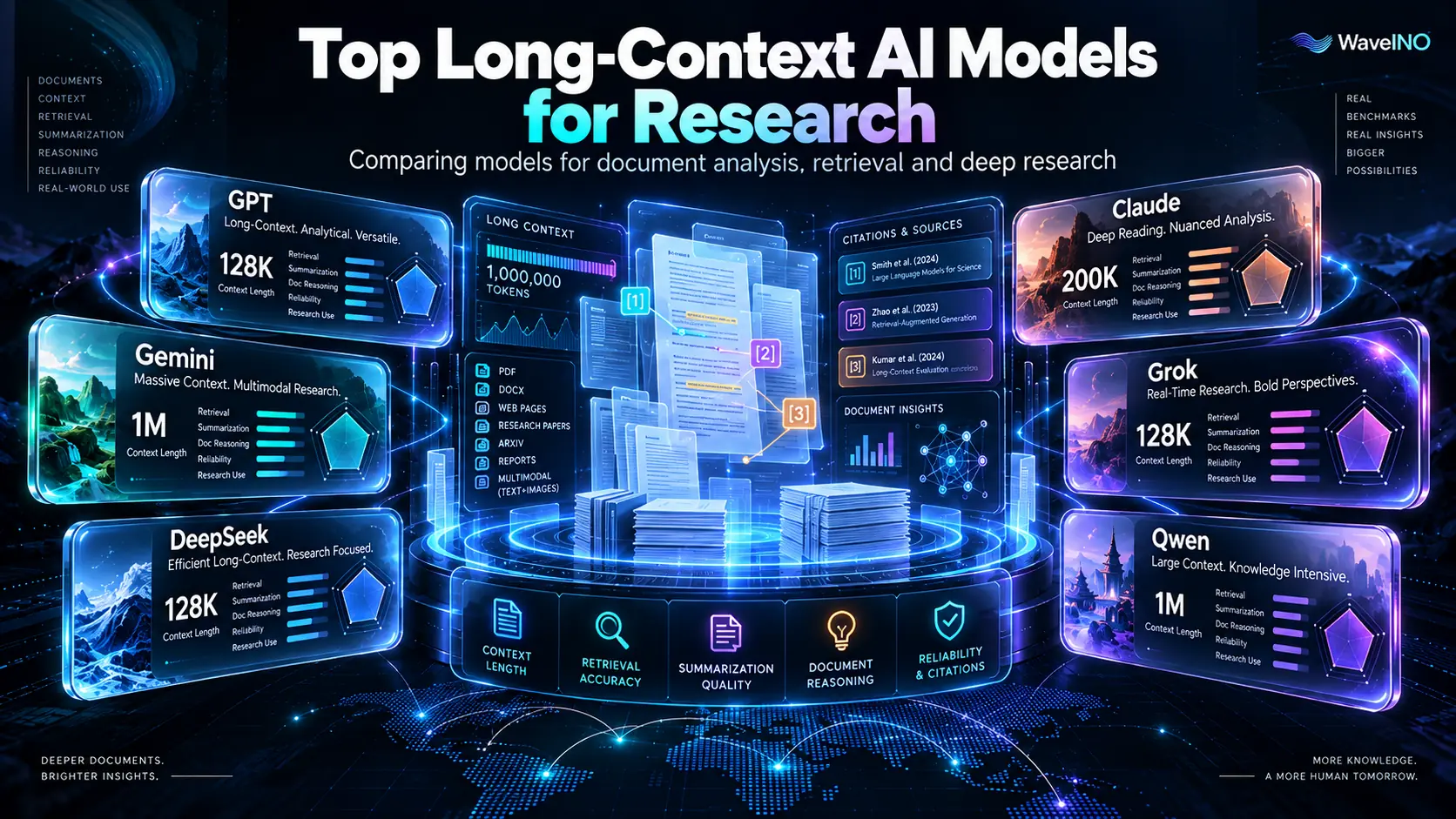
Editorial transparency: A leaderboard score depends on the exact model variant, evaluation date, prompt mix, sampling and test rules. Figures printed inside the creative cover are decorative, not verified performance measurements. We use independent benchmark snapshots where possible and do not award a fictional overall percentage.
The context window is a capacity limit, not a promise of recall
A context window describes how much input and output a model can process within its operating limits. It does not guarantee the system can reliably find a small detail buried anywhere in a huge document collection. Performance can change with position, file format, question difficulty and tool configuration.
A chart claiming one million tokens is therefore not enough to choose a research system. Ask whether that capacity applies to the exact model variant, subscription or API endpoint being purchased, and test actual retrieval, answer faithfulness and costs.
What October 2026 comparisons can and cannot tell you
The October 8 Arena text leaderboard displayed context metadata for many model configurations, including large context allocations on Gemini and Claude entries. The leaderboard itself measures human response preferences, not accuracy at every document position.
Artificial Analysis v4.3.2 includes AA-LCR v1.1 and GDP.pdf, which test aspects of long-context retrieval and document reasoning. Prefer measured task results and the methodology over an advertised capacity number.
Shortlist models by document type
A researcher comparing long reports may test Gemini, Claude and GPT families at the exact available context configurations. A business with sensitive contracts may add an approved open-weight model or regional hosting provider. Another organization may prioritize lower-cost summary drafts and reserve a stronger model for difficult questions.
For scanned PDF files, first establish whether OCR, layout extraction, tables and images are supported. Many research failures originate before language-model reasoning begins: missing pages, incorrect reading order, corrupt tables or retrieval that omitted an essential paragraph.
When retrieval-augmented generation is more useful
Retrieval-augmented generation, often called RAG, fetches relevant passages from indexed sources before asking the model to answer. This can reduce the need to send entire libraries in one prompt and make source tracking easier. However, retrieval can fail if the search index or access controls are wrong.
Compare a full-document method and a retrieval method using the same held-out questions. Measure whether the cited passage actually supports the answer. A fabricated reference is worse than a candid “not found”, especially for policies, compliance documents and business contracts.
Measure reliability with a realistic research test
Prepare questions requiring one precise paragraph, a cross-document comparison, a numerical table lookup, a contradiction check and an answer that the files do not contain. Sample documents with different lengths and formats. Test middle pages as well as beginning and end pages.
Track answer correctness, citation precision, missing evidence, latency and per-document processing cost. Check if the model confuses older and newer versions of the same policy. Keep document permissions effective throughout retrieval and summarization.
Use a human verification step for consequential conclusions
AI is useful for making draft summaries, extracting candidate clauses and highlighting disagreements; it should not be represented as having verified legal, financial or scientific claims without evidence review. Build a process where staff can click a source location and inspect it before approving an action.
A durable workflow records document version, model version, retrieved passages and reviewer decisions, without exposing unnecessary confidential content. This makes future audits and corrections possible.
Frequently asked questions
Does a one-million-token window mean perfect recall?
No. Capacity and accurate retrieval are different properties. Test your actual document lengths and question types.
Is RAG always better than a long-context model?
Not always. Compare both under the same workload; retrieval can omit needed passages, and full context can be expensive.
Can an AI research assistant invent citations?
Yes. Verify that each cited document and passage exists and directly supports the claim.
Which model is best for PDFs?
The right answer depends on PDF layout extraction, actual retrieval performance, privacy and citation accuracy, not token limits alone.
Sources and benchmark methodology
- Artificial Analysis Intelligence Index v4.3 methodology and results
- Arena Text Overall leaderboard (8 Oct 2026)
For help choosing or integrating a model into an Indian business website or workflow, contact WaveINO. See WaveINO’s human approval workflow guide and chatbot handoff checklist for practical deployment controls.