What this guide covers: Compare leading AI model families in 2026 using sourced Arena and Artificial Analysis results, with practical strengths, costs and limitations.
Updated 12 October 2026. A “top model” headline is useful only if it explains the benchmark, the date and the business use case. This guide compares the major model families without pretending a single composite rank predicts every workload.
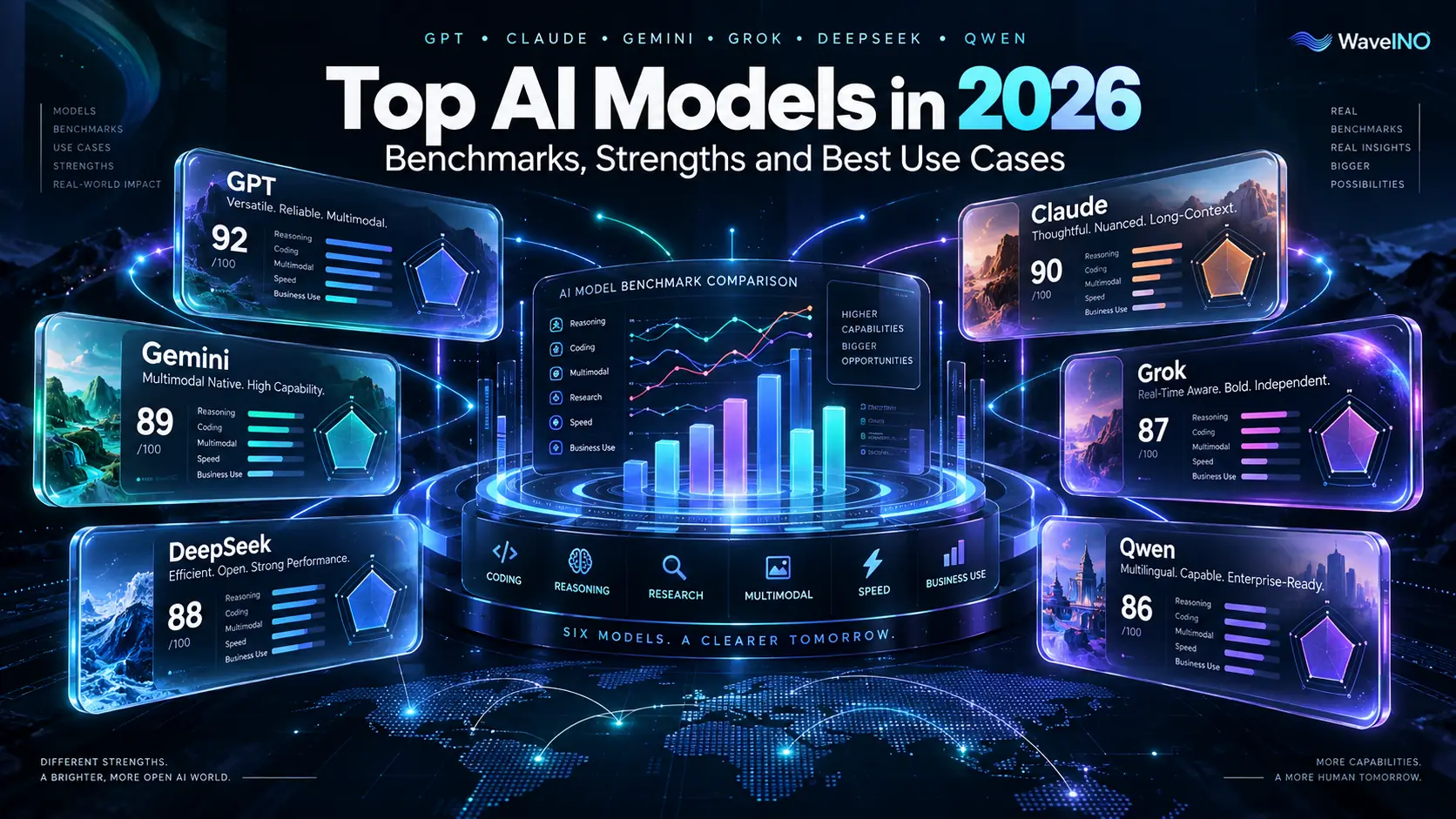
Editorial transparency: A leaderboard score depends on the exact model variant, evaluation date, prompt mix, sampling and test rules. Figures printed inside the creative cover are decorative, not verified performance measurements. We use independent benchmark snapshots where possible and do not award a fictional overall percentage.
What does “best AI model” mean?
There is no universal first-place system. Preference voting rewards answers people choose in side-by-side comparisons; task suites test specific reasoning, coding, agents and science problems. A model can lead a public chat leaderboard but be expensive, slow, unavailable through an API or unsuitable for confidential work.
For a defensible comparison, identify the specific model version and date. Track at least output quality, error rate, context reliability, per-task cost, data-handling rules and repeatability. Do not compare a provider’s strongest reasoning mode against another provider’s fastest economy setting without saying so.
A useful independent snapshot from October 2026
On Arena Text Overall dated 8 October 2026, Gemini 4 Argon High appeared first at 1534 ± 9 on the displayed raw-scoring view and was marked preliminary. Claude Opus 5.5 High followed at 1515 ± 8, with other Claude variants close behind. These are Arena preference ratings, not scores out of 100, and the rankings may change as votes accumulate.
A different result comes from Artificial Analysis Intelligence Index v4.3.2, which put Claude Fable 5.1 (max with fallback) and GPT-6 Astra (max) at 53 on its own index, with Claude Opus 5 (max) at 51. The index combines evaluations for agents, coding, general tasks and scientific reasoning. Neither number can be substituted for an Arena score.
How major model families fit different work
OpenAI GPT models deserve testing for general assistants, software workflows and reasoning, while the exact ChatGPT model and available API variant can differ. OpenAI announced a new GPT-6 ChatGPT rollout on 7 October 2026; read its official release note rather than assuming every named version is available in every product.
Anthropic Claude has competitive high-end entries in both Arena and Artificial Analysis results; compare Fable, Opus, Sonnet and Haiku variants separately for quality and operational cost. Google Gemini deserves attention for text preference and multimodal ecosystems, while launch and preview availability should be checked in the chosen product.
DeepSeek, Qwen, Grok and other alternatives should not be dismissed or uncritically grouped together. Some have open-weight or commercially attractive variants, while licensing, hosting location, safety controls and features differ by exact release. Arena’s open-license filter and provider model cards are starting points, not substitutes for testing.
Which metrics matter to Indian businesses?
A service business collecting enquiries should test Hindi and English accuracy, escalation to staff, form integration, refusal of unsupported promises and daily operating cost. A software team should test passing unit tests, edit review, secret handling and production deployment control. A business processing documents should test extraction fidelity and citations from its own files.
Benchmark advertisements often omit the total cost of retries, tools, context caching and quality control. Calculate cost per accepted completed task, not simply tokens per million. A cheaper model that needs frequent human repair can cost more in practice.
How to build a fair internal model comparison
Create 30–100 representative, permission-safe tasks, include easy and difficult examples, and define a rubric before comparing. Run the same prompt and source materials at specified model settings. Score correct outcomes, unsupported claims, speed and total operational cost; record every failure category.
Retest after meaningful model or application changes. Use current information from independent evaluators while documenting that providers, model aliases and leaderboards evolve rapidly. Choose a primary model and a fallback rather than binding every business function to a single winner.
Frequently asked questions
Which model is number one in October 2026?
There is no universal number one. The October 8 Arena raw-text snapshot showed Gemini 4 Argon High leading that particular vote-based ranking, while Artificial Analysis v4.3.2 tied Claude Fable 5.1 and GPT-6 Astra on its own index.
Are the numbers on the WaveINO cover benchmark scores?
No. The creative visual uses illustrative ratings. Only the dated measurements explicitly linked to independent sources in the article are factual comparisons.
Are open-weight AI models always cheaper?
Not necessarily. Hosting infrastructure, license conditions, operations and task reliability may outweigh lower inference prices.
How should a business make the final choice?
Use a representative internal task set, security and compliance constraints, and cost per verified result. Recheck the choice after model updates.
Sources and benchmark methodology
- Arena Text Overall leaderboard (8 Oct 2026)
- Artificial Analysis Intelligence Index v4.3 methodology and results
- OpenAI GPT-6 launch (7 Oct 2026)
- Anthropic official model lifecycle documentation
- Arena comparison of openly available model licenses
For help choosing or integrating a model into an Indian business website or workflow, contact WaveINO. See WaveINO’s human approval workflow guide and chatbot handoff checklist for practical deployment controls.